

Welcome here .......
Computer Operator Syllabus Part II Second Paper JOB Based Knowledge
Computer Fundamentals
1.1. Definition, History, Generation, Characteristics, Types
& Applications of Computers
1.2. Overview of a computer system
1.2.1. Data and data processing
1.2.2. Hardware: Definition; Input Unit, CPU, Output Unit;
Storage devices: Primary & Auxiliary Memory
1.2.3. Software: Definition; Types of Software; Programming
Language& its types
1.2.4. Firmware and Cache Memory
1.3. Concept of Multimedia
1.4. File Management
1.4.1. Physical Structure of the disk
1.4.2. Concept of File and folder
1.4.3. Type of files and file extensions
1.5. Introduction to ASCII and Unicode standards
Operating System
2.1. Introduction to Operating System
2.2. Types of Operating System
2.3. Functions of Operating Systems
2.4. Command Line operation (e.g. copy command, move
command, command to view and set different file attributes, etc.)
2.5. Windows Operating System
2.5.1. Introduction to Graphical User Interface (GUI)
2.5.2. Basic Windows Elements – Desktop, Taskbar, My
Computer, Recycle Bin,
2.5.3. Starting and shutting down Windows
2.5.4. File Management with Windows Explorer
2.5.5. Windows applications: (Control Panel, Character Map,
Paint)
2.5.6. Finding files of folders and saving the result
2.5.7. Starting a program by command line operation
2.5.8. Changing window settings: Adding/Removing programs;
Clearing the contents of document menu; Customizing the taskbar; Control panel
items
2.5.9. Creating shortcut (icons) on desktop
2.5.10. System tools:disk scanning, disk defragmenter,
backup, restore, format
Word Processing
3.1. Concept of Word Processing
3.2. Creating, Saving, Opening, Previewing and Printing
documents; Changing Default settings
3.3. Elements of Word Processing Environment (Menu,
Toolbars, Status bar, Rulers, Scrollbars)
3.4. Copying, Moving, Deleting and Formatting text (Font,
Size, Color, Alignment, line & paragraph spacing); Finding and Replacing
text; Setting Page Layout
3.5. Creating lists with Bullets and Numbering
3.6. Creating and Manipulating Tables; Borders and Shading
3.7. Use of Indentation and Tab Setting; Creating Newspaper
Style Documents using Column
3.8. Inserting Header, Footer, Footnotes, Endnotes, Page
Numbers, File, Page break, Section break, Graphics, Pictures, Charts, Word Art,
Symbols &Organization Chart
3.9. Mail Merge
3.10. AutoCorrect, Spelling and Grammar Checking, and
Thesaurus
3.11. Security Technique of Documents
3.12. Familiarity with Devanagari fonts
Electronic Spreadsheet
4.1. Concept of Electronic Spreadsheet
4.2. Organization of Electronic Spreadsheet application
(Cells, Rows, Columns, Worksheet, Workbook and Workspace)
4.3. Creating, Opening, Saving, Page Setting, Previewing and
Printing Work Book; Changing default options
4.4. Elements of Electronic Spreadsheet Environment (Menu,
Toolbars, Status bar, Rulers, Scrollbars)
4.5. Editing, Copying, Moving, Deleting Cell Contents;
Formatting Cells (Font, Border, Pattern, Alignment, Number and Protection);
Formatting Rows, Column and Sheets
4.6. Using Formula – Relative Cell and Absolute Cell
Reference
4.7. Using basic Functions
4.8. Generating Series; Sorting and Filtering Data;
Summarizing Data with Sub Totals
4.9. Creating Charts
4.10. Inserting Header and Footer
4.11. Spell Checking
4.12. Importing data from and Exporting into other formats
4.13. Familiarity with Devanagari fonts
Database System
5.1. Introduction to Data, Database and DBMS
5.2. Basic Concept of Tables, Fields, Records, Relationships
and Indexing
5.3. Introduction to database application
5.3.1. Data Types
5.3.2. Creating, Modifying & Deleting Tables
5.3.3. Establishing relationships among tables
5.3.4. Formatting and validating field data
5.3.5. Inserting, Modifying, and deleting data
5.3.6. Creating, Modifying, Deleting and Using simple
Queries / Forms / Reports
Presentation System
6.1. Introduction to presentation application
6.2. Creating, Opening & Saving Slides
6.3. Formatting Slides
6.4. Slide Show
6.5. Animation
6.6. Inserting Built-in picture, Picture, Table, Chart,
Graphs, and Organization Chart etc.
Web Designing and Social Media
7.1. Introduction to Web Page and CMS (Content Management
System)
7.2. Designing Simple Webpage with HTML
7.2.1. HTML Document
7.2.2. HTML Tags
7.2.3. Working with Text, Hyperlinks, Images, Lists, Forms,
Tables, Frames, etc.
7.3. Familiarity with Cascading Style Sheet, Rich Site
Summary and social networking
7.4. Use of Social Media in governance
7.4.1. Introduction to Social Media
7.4.2. Social Media Platforms
7.4.3. Applications in government organizations
7.4.4. Operating and Managing Social Media
Computer Network
8.1. Basic Networking: definition, types, and topologies
8.2. Connectivity and media: Network cables and connectors
8.3. Introduction to Network Devices (Hub, Switch, Router,
Gateway etc.)
8.4. Network cabling and cable testing
8.5. Familiarity with IP Addressing, subnet mask, gateway,
DNS, static and dynamic address assignment
8.6. Application of Network utilities (e.g. IPCONFIG, PING,
TRACERT, NSLOOKUP)
8.7. Concept of E-mail / Internet / Extranet/Intranet, World
Wide Web (WWW)
8.8. Familiarity with internet browsers (Internet explorer,
Firefox, Opera, Safari, Google Chrome, etc.)
8.9. Familiarity with Cloud-based services (Dropbox, Google
Cloud, iCloud, etc.)
Cyber Security
9.1. Introduction to Cyber Security
9.2. Common security threats: Social engineering;
Distributed Denial of Services; Malwares: Phishing, Spyware, Viruses, Worms,
Trojans, etc.
9.3. Security Mechanisms
9.3.1. Identity and Access Control
9.3.2. Use of Firewalls, IDS and IPS
9.3.3. Email Filtering
9.3.4. Use of antivirus software
9.4. Digital Signature: Concept and Applications
Hardware Maintenance and Troubleshooting
10.1. Configure Power Supply, Motherboard and System
Devices, BIOS settings, input/output devices, UPS
10.2. Types and features of display devices (CRT, LCD, LED,
Plasma)
10.3. Connector types (BNC, RJ45, HDMI) and associated
cables
10.4. Troubleshooting of computer and its peripherals
(keyboard, mouse, printer, scanner, speaker)
10.5. Troubleshooting of connectivity (cables, network, etc)
10.6. Installation and Troubleshooting of operating system
(Windows, Linux etc.)
10.7. Installation of Device Drivers, Configuration and
Installation of Application Programs and System Restore.
10.8. Data Backup: Concept and Methods
Relevant Legislations and Institutions
11.1. ICT Policy, 2072
11.2. Electronic Transaction Act, 2063
11.3. Information Technology Emergency Response Team (ITERT)
Operation and Management Directive, 2075
11.4. Government Website Development and Management
Directive, 2078
11.5. Roles of related Institutions:
11.5.1. Ministry of Communication and Information Technology
11.5.2. Department of Information technology
11.5.3. National Information Technology Center / Government
Integrated Data Center
11.5.4. Security Operation/Monitoring Center
Computer Operator Syllabus Second Paper Syllabus Topic Wise
Computer Fundamental – 2 Questions
Operating System – 2 Questions
Word Processing – 3 Questions
Electronic Spreadsheet – 3 Questions
Database Management System – 3 Questions
Presentation System – 1 Questions
Web Designing & Social Media- 1 Questions
Computer Network- 2 Questions
Cyber Security- 2 Questions
Hardware Maintenance & Troubleshooting- 2 Questions
Related Legislations & Institutions- 4 Questions
Total Questions – 25
Computer Operator Practical Exam Syllabus Topics
Devanagari Typing – 5 Marks
English Typing – 5 Marks
Word Processing – 12 Marks
Electronic Spreadsheet – 12 Marks
Database Management System – 6 Marks
Presentation System – 5 Marks
Web page Designing – 5 Marks
Total Marks – 50
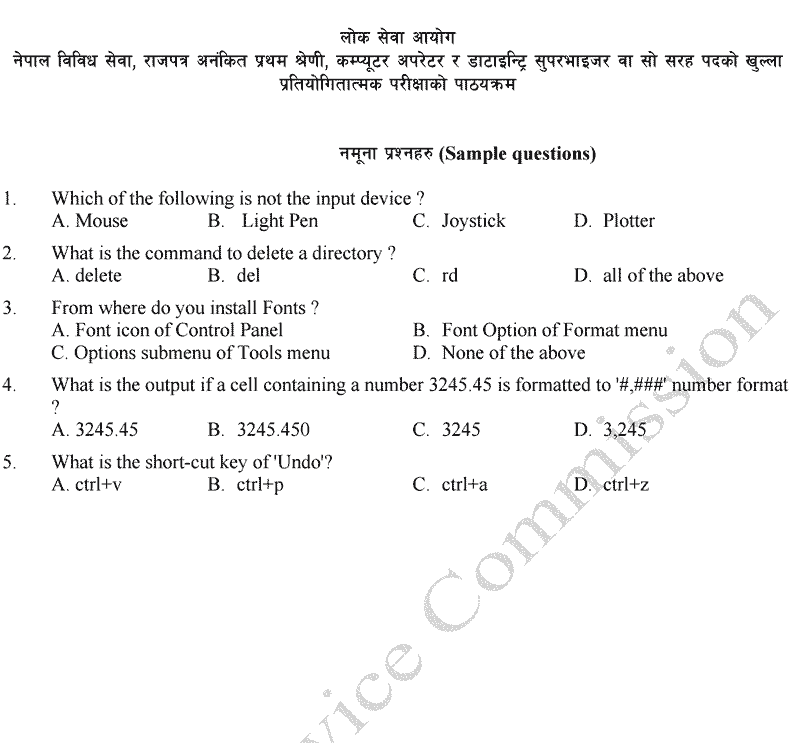
Computer Operator Important Model Questions Answer Lok Sewa


0 Comments